The Oxfordshire Chilterns
The Chiltern Hills are a chalk escarpment that stretch 47 miles from Goring and Whitchurch on the River Thames north-west to close to Hitchin in Hertfordshire. Several of the South Oxfordshire villages are within the Chilterns
Area of Outstanding Natural Beauty.
The scarp slope (the steep slope) of the Oxfordshire Chilterns is above the villages of Watlington, Lewknor and Chinnor, and from high in the hills above these villages there are panoramic
views towards the Oxfordshire Plain and
the distant hills. From its highest points the Chilterns fall gently south towards the Thames at Goring, Whitchurch and Mapledurham,
and east also towards Henley-on-Thames.
The Chilterns have been heavily wooded for hundreds of years, mainly with beechwoods, but ash, cherry and oak are also widespread. The Chilterns used to support a wide range of woodland industries including chair-making. Now though the amenity, recreation and wildlife value of the woods are equally important. Unfortunately the beech woods are aging and there is little replanting, perhaps because of the decline in the chair-making industry.
Where the landscape is not wooded agriculture makes a major contribution to the appearance of the Chilterns landscape. Agriculture accounts for about 75% of the total area of the AONB and much of the area is devoted to arable crops. On much of the steep scarp slope however there is grazing and increasingly nowadays that means sheep rather than cattle. In many parts of the scarp slope bushes and trees have colonised and changed the appearance of the landscape.
Chalk streams are an attractive feature of the Chilterns and are an important habitat for wildlife and they support a massive range of plants and animals. There are 200 or so chalk streams in the world, so globally they are rare, but over 160 of these streams are to be found in England.
Wherever you are in the Chilterns and many of the surrounding areas you are likely to see (and hear) red kites. By the end of the nineteenth century red kites were persecuted to extinction in England although a small population survived in Wales. However between 1989 and 1994 the RSPB and English Nature (now Natural England) imported and released red kites from Spain into the Chilterns and now they are widespread again. The kites started breeding in the Chilterns in 1992 and it is thought that there could now be over 600 breeding pairs in the area. Chicks have now been taken from the Chilterns to reintroduction sites in other parts of the country.

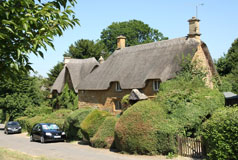
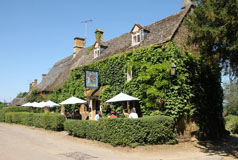
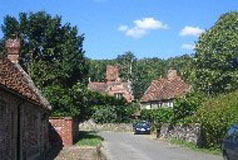
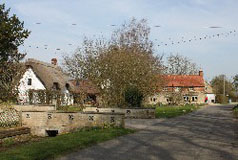
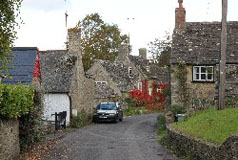
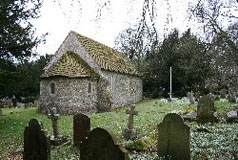
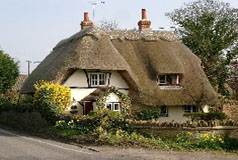
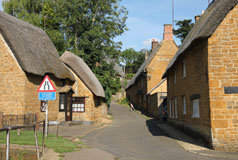
Older buildings in the Chilterns have a distinctive character consistent with the use of local materials. Bricks and tiles have been readily available, produced from clay dug out of the fields and woods. Flint from the chalk of the hills and the overlying clay frequently was used in walls and many cottages and churches built with flints can be found all over the area.
| Villages in the hills: |
|
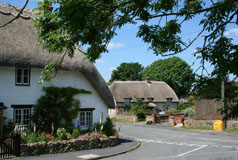
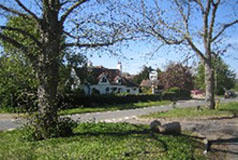
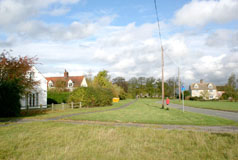
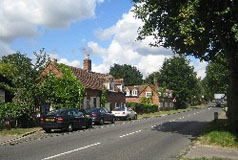
Cookley Green
The
hamlet of Cookley Green is high in the Chilterns about
half way between Nettlebed and Watlington along the
B481. There are only a score or so of attractive houses
and cottages but they are set neatly around a small green with the
main road running through the centre. The road is lined
on both sides by attractive, mature trees and the overall
effect is very pleasing!
|
Swyncombe
The Swyncombe
settlement, which comprises Swyncombe House and its cluster
of farm and other estate buildings, dates from at least Saxon times and in its
secluded valley the Manor, church and farm formed an enclosed
medieval community. The present
manor house at Swyncombe is a 19th-century rebuild of
a fine Elizabethan house but the manor of Swyncombe was originally
part of the manor of Ewelme and there has been a manor
house here for hundreds of years.
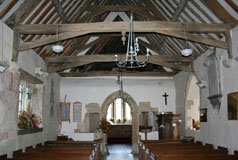
The
small Norman Church of St Botolph, which was probably constructed
in the 11th century, is of flint and stone and has been largely
untouched over the centuries. It has traces of early wall-paintings which
include some thought to have been painted by medieval
knights leaving for the Crusades. February sees masses
of snowdrops and aconites which are planted in drifts
around the church and people come from miles around each
year to see the display. |
Russell's Water
A
large pond, complete with ducks, gives the hamlet of Russell's
Water its particular character, and is quite unusual for
a village so high in the Chilterns. Russell's Water
is on the edge of the large area of common land known as Russell's Water and Maidensgrove
Common. |
Maidensgrove
Maidensgrove is a small hamlet which lies along a narrow lane between the hamlets of Russell's Water and Stonor, on the edge of the
large area of common land known as Russell's Water and
Maidensgrove Common. You could easily miss the hamlet as the houses of Maidensgrove are all away from the road, mostly along
a narrow winding lane which ends eventually at a farm
and an entrance to the Warburg
Nature Reserve.
|
Stonor
Stonor is a small community consisting of just a few houses
and cottages and a farm and which spreads for a short distance along a typical Chilterns valley on a road from Henly-on-Thames towards Watlington, passing
through Lower and
Middle Assendon on the way.
Overlooking
the hamlet is Stonor
Park, a landscaped deer park, and Stonor House which
has been the home of the Stonor family for more than eight
centuries. The
earliest part of the house dates from the 12th century,
whilst most of the house was built in the 14th century. |
Nettlebed
Nettlebed
is in attractive wooded countryside on high land on the A4130 between
Wallingford and Henley-on-Thames. The village is surrounded by large
areas of common land and is the highest in the South Chilterns.
Clay suitable for pottery and brick making was found locally
and, as a result, Nettlebed was the most important brick
and tile making centre in the Chilterns from the mid-14th
century onwards. A disused lime kiln is prominent in the
centre of the village which was in use until 1938 and
was restored in 1972-4.
|
Nuffield
Nuffield is a small village half a mile south of the A4130
Wallingford to Henly road, about two miles west of Nettlebed in the heart of the Oxfordshire Chilterns. The village
has an attractive common which is home to a golf club.
On
the north side of the main road, opposite the golf course, is Nuffield
Place, the
former home of William Morris, Lord Nuffield. Built
in 1914, Nuffield Place is a good example of a
complete, upper-middle class home of the 1930s. It contains
an interesting collection of Nuffield memorabilia and
is furnished and equipped precisely as it was when Lord
Nuffield died in 1963. |
|
Checkendon
Checkendon
is a pleasant rambling Chilterns village between Woodcote and Stoke Row, north of the
A4074 between Wallingford and Reading. It is surrounded
by beech woods, with bluebells in the spring, and the
rich colour of the autumn leaves. The older part of the
village is centred around the Church
of St. Peter and St. Paul. The area around Checkendon
Court and St. Peter's and St. Paul's Church is a conservation
area. |
Woodcote
Woodcote
is at one of the highest points in the South Chilterns. It
is a large, some would say rather characterless, South
Chilterns village situated about three miles west of Goring and a mile south of the A4074 road from Wallingford to
Caversham. A green, a village
hall, a couple of modern shops, a couple of churches and schools and lots of houses!. The village is rather a dormitary village and many people enjoy living there. Most of the population probably commutes to Reading and other towns. |
Stoke Row
Stoke
Row is at one of the highest points of the southern Chiltern hills
between the Wallingford to Reading and the Wallingford
to Henley roads, about 3 miles NW of Sonning
Common.
In
the centre is a village store and a garage and an attractive
Indian-style well and a cherry orchard. The 365 feet deep
well is known as the Maharaja's Well and was dug in the
C19 entirely by hand as a gift from the Maharajah of Benares
due to his friendship with a prominent local landowner. |
|
Bix
Byxe Brand was a Saxon settlement situated in the area
around the ruins of the ancient parish church of St James
at Bix Bottom, now a delightfully quiet area well off
the beaten track along a road which leads to the Warburg
Nature Reserve. The church was originally a tiny Norman
Church and was built
on a Saxon site. The ruins of the old church can still
be seen and remain as consecrated grounds.
The small village of 'modern' Bix is just off the busy A4130
trunk road between Henley-on-Thames and Wallingford and
is close to the location of Saxon settlements known as Byxe/Bixa Gibwin/Gibwyn. There
appears now to be little evidence of historic Bix and
the village now comprises mainly up-market houses spread around
three sides of an open grassed common and out along the
roads to Lower and Middle Assendon. The 'new' parish church
of St James was built in the centre of the village in
1875.
An
interesting feature in the village is a restored victorian brick-lined
open water tank which was constructed c.1895.
|
The Assendons
The hamlets of Lower and Middle Assendon are in the low-lying
Stonor Valley on the B480 which leads to Watlington. Lower
Assendon, in particular, has some attractive old cottages.
The names were first recorded in 800 AD as Assundene which
was thought to derive from the Saxon word "denu", meaning
a long, narrow, winding valley, and "assa", meaning an
ass; together this was translated as the Valley of the
Wild Ass. Assundene changed to Afsington and then to Assendene.
This was the name of the hamlets until the early 20th
century, when the modern name of Assendon came into use. |
|
Binfield Heath
Binfield
Heath is midway between Henley-on-Thames
and Caversham, just over a mile from the River Thames almost
on the county boundary. Most of the houses are near the two village shops and
recreation ground. Prominently at the centre of the crossroads is
a fine chestnut tree, which has always been a well known local rendezvous.
An interesting feature of Binfield Heath is an unusual
covered well, called Keeps Well. This has recently been
completely rebuilt exactly as before as the original was
completely demolished a few years ago in a motoring accident.
Next to the well one of the village ponds has been restored too and this is known as Green Pond.
This area of the village was formerly known as Shiplake
Common. |
Harpsden
The
village of Harpsden is a mile or so south
of Henley-on-Thames and a mile and a half from the River
Thames and the county boundary. As well as the small village of Harpsden the parish includes several nearby hamlets
including Harpsden Bottom. Between and to the south of
Harpsden and Harpsden Bottom is an area of open-access
woodland known as Harpsden Woods. |
|
Kidmore End
Kidmore End is a pleasant village with most of its houses
grouped around the church and the crossroads. The parish
church is the Church of St. John The Baptist - a Victorian
church with a high dome above the alter. In the graveyard
are the obligatory yews, and here they are magnificant.
Those over the gateway in particular! Adjacent to the
church is the village school, which was established in
1862.
A landmark in the village is the late C19 well with its
pyramidal wood shingle roof standing in the centre of
the road junction outside the church. Although it is no
longer used it is in extremely good condition having more than once in its lifetime been
saved from demolition. |
Gallowstree Common
Gallowstree Common is named after on oak tree in the village that was used, as its name
implies, as a gallows. It is thought that the last hanging
was in 1825 for sheep stealing. The tree no longer stands
and its stump was removed at the time of the village enclosure.
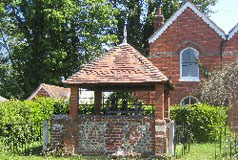
Gallowstree Common has an interesting well. The wellhouse
has low red brick and flint-panelled
walls and is a listed building. One side of the wellhouse is completely open for
access to the well and its iron winding gear.
|
Rotherfield Peppard
Rotherfield
Peppard (known also just as 'Peppard') is just north of Sonning
Common on the B481 road which links Caversham and Nettlebed. It is situated
on an old overland pack route from Henley to Goring which can still be traced, partly on footpaths and partly
on modern roads. The pack route is thought to be the origin
of pub names such as the Pack Horse and the Pack Saddle
which, although not in the village, are not far away.
In
the centre of the village is Peppard Common and the village
spreads out around two-and-a-bit sides of the common, with
the main road passing through the middle. All Saints' Church
is at the end of a residential lane leading from the common. There is
also a primary school in the centre of the village.
|
Sonning Common
Sonning
Common is a large village on the B481 road between Reading
to the south and Nettlebed to the north. Once it was apparently a community of scattered
cottages, farms and beerhouses. Local pastures were used
for grazing and pigs were allowed to feed on beech mast
in the woods.
The settlement was originally mainly on the road that leads to Kidmore
End. However in the first half of the last century housing
began to spread southwards along the road towards Caversham
with the result that now Sonning Common is a dormitory village. |
Villages at the foot of the scarp slope: |
|
Chinnor
Chinnor is a large village
at the base of the Chilterns approximately four miles
south of Thame on the B4009. Originally the village
appears to have been mainly around the four roads Station
Road, Church Road, High Street and Lower Road. However the village
has now grown considerably, especially to the west.
Industries
based in and around Chinnor have included lacemaking,
chair-making and agriculture and, until 1999, a cement
works whose tall chimney was a well-known local landmark.
High
above the village on Chinnor Hill is Chinnor
Hill Nature Reserve which is run by the Berkshire,
Buckinghamshire and Oxfordshire Wildlife Trust.
Chinnor
is the terminus of the Chinnor
& Princes Risborough Railway, which was part of the old Great Western Railway line
between Watlington and Princes Risborough but was
closed to passengers by BR in 1957. The section between
Chinnor and Princes Risborough then carried a freight-only
service until 1990 but is now a heritage line. |
Crowell
Crowell is a tiny spring-line village at the foot
of the Chilterns just outside Kingston Blount a mile or so south west of Chinnor. The name is thought to be derived from a well
or spring where crows gather! Unlike neighbouring Kingston Blount,
and despite being such a tiny village, Crowell has a parish
church, the church of the Nativity of the Blessed Virgin
Mary. Although largely reconstructed in about 1880, parts
of the church date from the 13th century. |
Kingston Blount
Kingston
Blount is a spring-line village at the foot
of the Chilterns a mile or so south west of Chinnor
on the B4009. There are a
few cottages on the main road, also the village pub, but much
of the village is actually way from the main road.
In
the 19th century Kingston Blount had a number of pubs,
a draper, grocers, wine merchants, a smithy, corn merchant,
butcher, baker, post office and a school and was considered
to be a large and respectable town. Now, like in many
villages, the shops have all closed and there now remains
just one pub. |
Aston Rowant
Aston Rowant is a pretty little brick and flint village
lying at the foot of the Chilterns
just off the B4009, although there has been some ribbon
development along the main road.
The 12th century church of St Peter and St Paul is in
the oldest part of the village. The church is surrounded
by trees and in spring daffodils and
blossom make the bank of the churchyard a pretty sight.
The road winds through the village towards the village
green. The green is dotted with
trees and also has attractive daffodils in the spring. Around
the green is a farmhouse and cottages, which were mainly
built in the 18th and 19th centuries. |
Lewknor
The
village of Lewknor is a quiet village at the junction
of the M40 motorway and the B4009 right at the foot of
the Chilterns where the motorway passes through the Stokenchurch
cutting. Since the construction of the motorway the B4009
has become a bypass for the village and the motorway has
blocked the direct road from the village to Aston Rowant meaning there is now little through traffic through the village.
Many
of the cottages in Lewknor are built using flints and
some of the newer construction has been sympathetically
built in a similar style using the same materials. At
the centre of the village is the remnant of Town Pond
which at one time was used for watercress growing. The
cress was sent to London by train from the nearby halt
on the Watlington to Princes Risborough branch line (now
no longer there). |
Shirburn
The tiny village of Shirburn straddles the
B4009,
but don't blink or you might miss it as you concentrate
on the sharp bends in the road at that point! Off the
main road there are a few houses and on the main road
there are even fewer!
The main interest in this village
is Shirburn castle, a fortified manor house built in 1378
with four towers and a gatehouse and surrounded by a moat. Unfortunately
the castle is now empty and in need of substantial repair. |
|
Watlington
Watlington is an ancient market
town and it claims to be reputedly the smallest town in
England. But, Watlington is not listed on the South
Oxfordshire District Council's websites as a town,
so I feel justified in including Watlington here as one of Oxfordshire's
villages. Watlington has lots of character and it would
have been a real pity to have excluded it.
The
village's position at the foot of the Chilterns and on
the edge of the Vale of Oxford adds to its character,
for here we start to see some Chilterns-style flint buildings
as well as timber framed and thatched cottages although
most of the buildings are built of brick. With its fine
selection of small shops, the dominating 17th century
town hall and many historic buildings dating back to that
period, and before, in all Watlington is a very attractive
village. Unfortunately though, Watlington's narrow
streets were just not designed to cope with modern traffic,
hence it has to suffer an awful lot of congestion.
High on the scarp slope above the village is Watlington Hill Nature Reserve which is owned by the National Trust. |
Britwell Salome
Britwell
Salome is at the foot of the steep slope of the Chilterns,
about a mile south-west of Watlington along the B4009.
From the main road it appears to be little more than a few houses, a pub
and a farm and it actually is a very small village. Off
the main road on either side however are more houses,
the main, and older, part of the village being to the
south with a few newish houses to the north.
To
the north-east of the village, next to the site of Britwell
Priory and down a short lane, is the parish church of
St. Nicholas which dates from the 13th century. On the
site of Britwell Priory there is now an C18 farmhouse.
Adjacent to the church is the Old Rectory which dates
from the 17th century. |
Ewelme
Ewelme is an interesting and attractive village and is a delight
to visit. It lies in a small valley just south of the
B4009 Benson to Watlington road about 5 miles east of Benson. The name means (place
at) the river-source - the river being the small chalk
stream, the Ewelme Brook.
The
Ewelme Brook was at one time used extensively for the
cultivation of water cress. However during the last quarter
of the 1900s, regulations prevented the sale of watercress
from Ewelme and this, together with greater competition
from other areas and countries, led to the industry's
demise and production ceased in 1988. The Ewelme
water cress beds are now owned and managed by the Chiltern
Society as a local nature reserve. They run the whole
length of the village and are accessible from the road
in places.
In
the centre of the village is the source of the Ewelme
Brook and an attractive pond. Beside this a small development
of late 20th century houses blends almost perfectly with
the older village properties in the High Street.
At
the west end of the village on slightly higher ground
is the large and attractive parish church of St. Mary
the Virgin. From
the west door of the church is a covered passage that
leads to the Cloister - a square courtyard surrounded
by thirteen red brick almshouses which were established
in 1437. The almshouses are the oldest brick buildings
in this part of the country. Next to the Cloister is Ewelme
school which was founded originally as a superior grammar
school. Now the school is a state primary school and is
the oldest school building in the country still in use
as a state primary school. |
| Thames-side villages: |
|
Crowmarsh Gifford
Crowmarsh
Gifford is on the eastern bank of the River Thames opposite
the historic town of Wallingford, the two being connected
by Wallingford Bridge. Since 1987 the village has been
bypassed by the busy A4074 Reading to Oxford road and
now the Wallingford bypass also bypasses the village,
so there is now less through traffic. |
North Stoke
North Stoke is a delightful small Thames-side village
lying just off the Goring to Crowmarsh road. The
village itself is on a sleepy backwater, but most people
will perhaps know the village as the home of The Springs
Hotel and Golf Club which is on the "main road".
The parish church is the Church of St. Mary, which
is almost entirely medieval, and still has wall paintings,
ancient oak pews and a brick floor. |
|
South Stoke
South
Stoke is another delightful village, sandwiched between the River Thames and
the main railway line from Paddington to Oxford and the
south-west. Access to the village from the Goring to Crowmarsh road is by way of one of three arched bridges,
whilst a fourth way through the railway embankment, known
locally as the Bogey Hole, enables a footpath to the hamlet
of Little Stoke.
Unlike the railway, which is very evident,
you may not realise the river
was there unless you looked at a map or wandered down
the track to the old ferry crossing to Moulsford!
Perhaps though the Perch and Pike pub gives the closeness
of the river away, both by its name and its display of
record catches of fish from the river! |
Goring
It is probable that everyone
who has heard of Goring associates it with the attractive
gap between the Berkshire Downs and the Chilterns known
as the Goring Gap. Here the Oxfordshire village of Goring and the Berkshire village of Streatley
stand on opposite sides of the River Thames, linked by
a fine bridge which was built in 1923. The beautiful riverside
setting and the attractive views of the hills on either
side make Goring an extremely attractive village.
The river was first forded by the Romans who built a causeway.
The first bridge over the river, a toll bridge, was built
upstream of the ferry in 1837. This lasted until the present
bridge was built in 1923 and from it you can look down
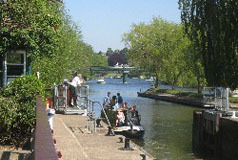
on Goring lock and the weir. The present lock was built
in 1921 and was then unusual in that it had an extra pair
of lock gates, creating two chambers.This enabled boats
to travel faster through the lock and use less water each
time the lock was used. |
|
Whitchurch-on-Thames
is an attractive Thames-side village about half way between Goring and Reading. On the opposite
side of the river, and linked to Whitchurch-on-Thames
by Whitchurch Bridge is the Berkshire village of Pangbourne.
Approaching Whitchurch-on-Thames by road from the north
the road drops down from the Chilterns into the villlage,
much of which is squeezed into a flat plain about half
a mile wide. Before you realise it you have reached a
toll bridge across the river to Pangbourne.
The village has several attractive flint cottages, Edwardian
villas and Georgian town houses. There is also a mill
which has now been converted and is no longer in use. |
Mapledurham
Mapledurham
is a small estate village on the north side of the Thames
a few miles west of Caversham. Facing Mapledurham on the
opposite bank of the river is the Berkshire village of Purley-on-Thames
which is effectively a suburb of Reading.
Visitors to Mapledurham are attracted mainly by Mapledurham
House and Water Mill. Mapledurham House is a Grade I Country
House c.1585 with C19 alterations and extensions. Most
of the village is a conservation area and there are 33
listed buildings in and around the small village, including
farmhouses, barns, stables, houses, cottages, statues,
etc. |
|
Shiplake
Shiplake
is south of Henley-on-Thames on the A4155 road which leads
to Caversham and Reading. Both the old village
of Shiplake and the newer settlement of Lower Shiplake spread away
from the road towards the River Thames.
The village originated near where the C12 Church of St
Peter and St Paul can still be found. This is where the
manor house (now known as Shiplake Court) was situated
on a beautiful site overlooking the river. The Manor house
was rebuilt in 1894 and is now a boys public school. However
on the building of the railway in 1858 and the station,
about a mile away from what had been the centre, a new
settlement grew around the ancient settlement of Lashbrook
which is mentioned in Domesday Book, along with its mill.
The mill was where Shiplake lock is now and existed until
1908. |
|